

&format=webp&quality=85)
The future of Corporate travel has entered a new era. After a turbulent period of pause and recession, 2026 will be defined not simply by a return to travel metrics but by how companies choose to travel. Budgets are being re-evaluated to reflect travel’s strategic value, if measured more rigorously, and three forces are converging to reshape business travel sustainability, technology, and experience. These factors interact with sustainable choices that are enabled by tech, and both influence the quality and outcomes of travel. Recent industry research shows travel programs are increasingly prioritising tech-enabled sustainability and richer traveller experiences as core KPIs, not just optional extras. This deep dive explores what sustainable business travel will look like in 2026, why these trends matter and practical steps organisations can take to build resilient, responsible, and high-value travel programs.
Macro picture: Demand, Budgets, and the New Normal
The headline: corporate travel is stabilising but evolving. After a strong rebound in nominal spending, the industry faced mixed signals. Budgets are rising modestly in many forms, but travel volumes and trip types have changed. Longer trips and multi-day managers report higher complexity inflationary cost pressures, supply chain and geopolitical risks, and a shared focus on providing travel’s ROI.
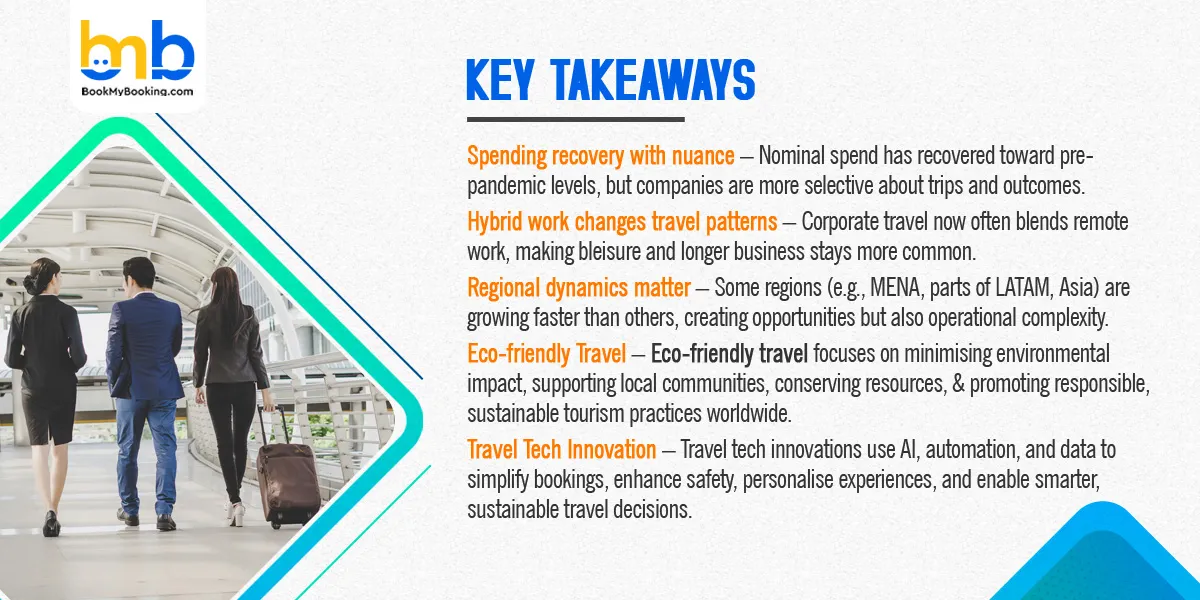
Understanding this macro context helps travel managers prioritise where to invest: technology to manage complexity, sustainability measures to meet stakeholder targets, and improvements to the traveller experience to retain talent and protect productivity.
Sustainability: From compliance checkbox to strategic advantage
Why sustainability is table stakes in 2026
Sustainable business travel is no longer just a CSR talking point; it’s a business imperative. Companies face regulatory pressure, investor scrutiny, employee expectations, and client demands to reduce emissions and demonstrate credible progress toward net-zero goals. The events and travel ecosystems are aligning around shared roadmaps (e.g., Net Zero Carbon Events, WTTC net-zero roadmaps) that outline measurable pathways for reducing greenhouse gas emissions across travel and events.
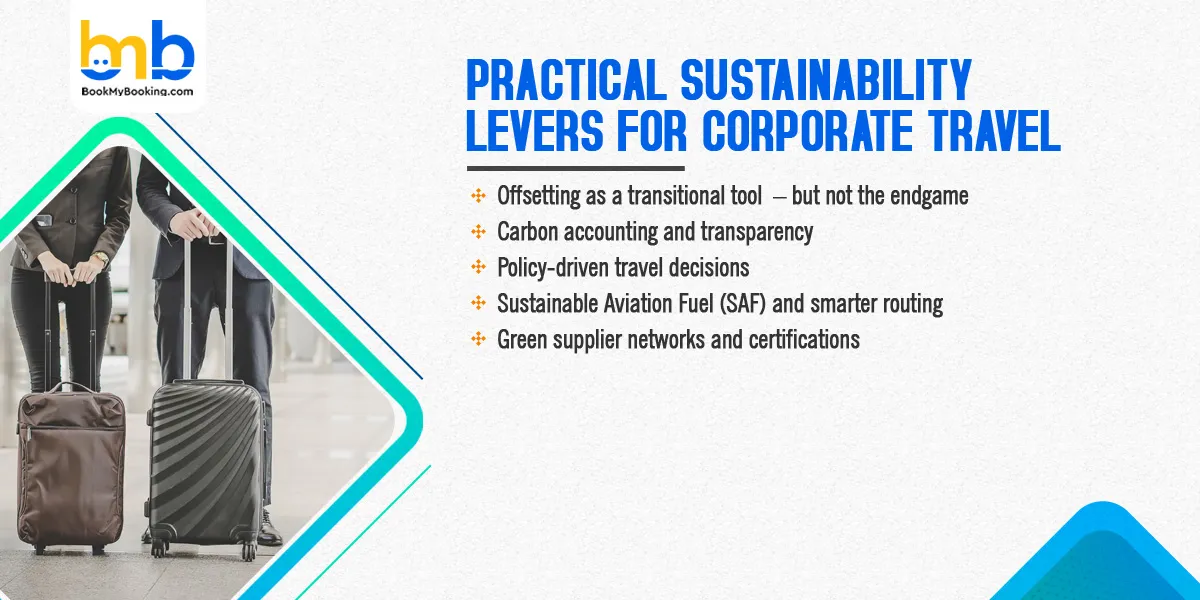
Practical sustainability levers for corporate travel
- Carbon accounting and transparency
Accurate measurement of travel emissions is the prerequisite to action. In 2026, travel programs will require integrated carbon and sustainable business travel, dashboards that combine flight, hotel, ground transport, and event emissions into a single report for procurement and sustainability teams. - Policy-driven travel decisions
Travel policies will embed carbon-aware rules: preferred suppliers with verified emissions reductions, limits on short-haul flights when rail alternatives exist, and approvals that consider carbon as well as cost. - Sustainable Aviation Fuel (SAF) and smarter routing
SAF uptake is accelerating, supported by airline and airport initiatives, but supply remains uneven. Procurement teams will negotiate SAF-inclusive contracts or, where available, prioritise airlines with SAF commitments. Route planning tools that minimise emissions (e.g., fewer connections, optimal aircraft types) will become standard, thus promoting eco-friendly travel. - Green supplier networks and certifications
Hotels, venues, and ground operators are increasingly certified for sustainability. Corporations will favour suppliers with credible certifications and verifiable decarbonization roadmaps. - Offsetting as a transitional tool — but not the endgame
Offsets will still be used where reductions are currently infeasible, but companies will treat high-quality offsetting as a bridge while emphasising direct emission cuts. Industry roadmaps encourage prioritising avoidance, reduction, and, only then, verified offsets.
The business case
Eco-friendly travel saves money and reputation when done strategically. Energy-efficient hotels, consolidated travel itineraries, and virtual/hybrid meeting options can reduce costs and carbon emissions simultaneously. Moreover, companies that demonstrate measurable sustainability credentials can attract clients, investors, and talent, making green travel a competitive advantage.
AI and Automation-Smarter booking and duty of care
- AI-driven booking assistants will move beyond simple suggestions to proactively craft travel itineraries that balance cost, carbon emissions, employee preferences, and policy compliance in the future of corporate travel as well. Natural language interfaces let travellers ask for “a low-carbon trip to Berlin, arriving Monday morning, under policy” and receive compliant options instantly.
- Automation for expense and policy compliance reduces manual errors and accelerates reimbursement while integrating carbon tags at the transaction level.
Data platforms and integrated dashboards
Travel programs will centralise booking, spend, carbon, and risk data into a single set of dashboards for CFOs, travel managers, and sustainability leads. These tools enable scenario modelling, e.g., what happens to the budget and emissions if sales meetings shift from air to rail, promoting the future of corporate travel.
Real-time risk and traveller tracking
Duty-of-care platforms will offer real-time alerts for disruptions, geopolitical events, or health threats. Integrated traveller apps provide two-way communication and one-tap emergency support — features now expected by travellers and corporates alike.
Contactless and biometric travel experience
Airports and hotels continue to deploy biometric and contactless solutions that speed throughput and reduce friction. These systems also support safer travel during health or security events and improve traveller satisfaction.
The rise of the marketplace and API ecosystems
Open APIs will connect future corporate travel booking systems to a broader ecosystem of suppliers (local mobility, coworking, health services). Travel managers will curate supplier pools via marketplace integrations, enabling flexibility without sacrificing control.
Experience: The human side of travel wins the day
While sustainability and tech shape how we travel, experience determines whether trips deliver value. In 2026, companies pay more attention to traveller wellbeing, meeting quality, and the intangible returns of face-to-face engagement.
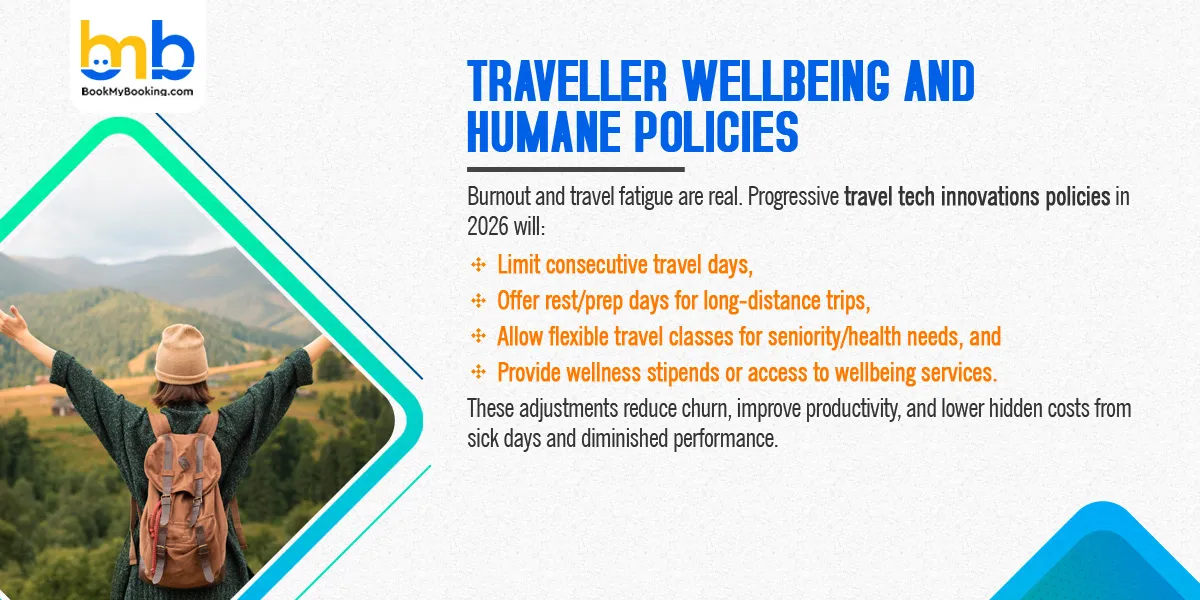
Hybrid meetings and purposeful travel
The most innovative organisations use hybrid tools to make travel more purposeful. Instead of duplicative trips, companies will combine in-person convenings with virtual work phases: pre-work to align objectives, a focused multi-day in-person sprint, and post-event deliverables. The goal is quality over quantity: fewer eco-friendly trips but higher impact.
Bleisure and extended stays
Longer stays that include blended work and leisure (bleisure) are both an employee perk and an efficiency opportunity. Companies will support bleisure when it enhances retention without compromising duty of care or budgets.
Local experiences and culinary diplomacy
Experiences matter: local dinners, curated cultural excursions, and chef-led private tastings are now part of the relationship-building process. Food, thoughtfully selected to be inclusive, regional, and memorable, often defines an event’s emotional impact. In 2026, future corporate travel programs will budget for curated local dining and small-group experiences as relationship investments.
Events & MICE: Hybrid, Local, and Sustainable
MICE (Meetings, Incentives, Conferences, and Exhibitions) will be a significant growth area, but with evolved expectations.
Hybrid-first event design
Event planners will default to hybrid designs that cater to both virtual and in-person audiences equally. This means investing in better AV, interactive platforms, and pacing that keeps both audiences engaged.
Decentralised and regional hubs
Large global conferences may be split into regional hubs connected virtually to reduce travel distances and emissions while preserving global collaboration.
Sustainable events
Event sustainability, promoting sustainable business travel, will be non-negotiable: venue selection, catering, material use, and attendee travel emissions are part of the event KPIs. Tools exist to calculate event carbon footprints, and frameworks (like Net Zero Carbon Events) guide 2030/2050 goals.
Policy & procurement: aligning governance with goals
Managers must translate strategy into actionable policy.
Policy modernization
Trip approval flows will be rewritten to include carbon considerations, meeting ROI checkpoints, and traveller wellbeing guards. For example, a policy might require CO₂ estimates for all international trips over a certain spend threshold, or require senior approval for non-rail short-haul flights, thus promoting eco-friendly travel.
Supplier partnerships and contracting
Sourcing teams will negotiate clauses for sustainability (e.g., measurable emissions reductions), SAF provisioning, and digital integration (APIs for real-time availability and carbon data). Preferred supplier programs will prioritise partners with transparent sustainability roadmaps.
Measurement and reporting
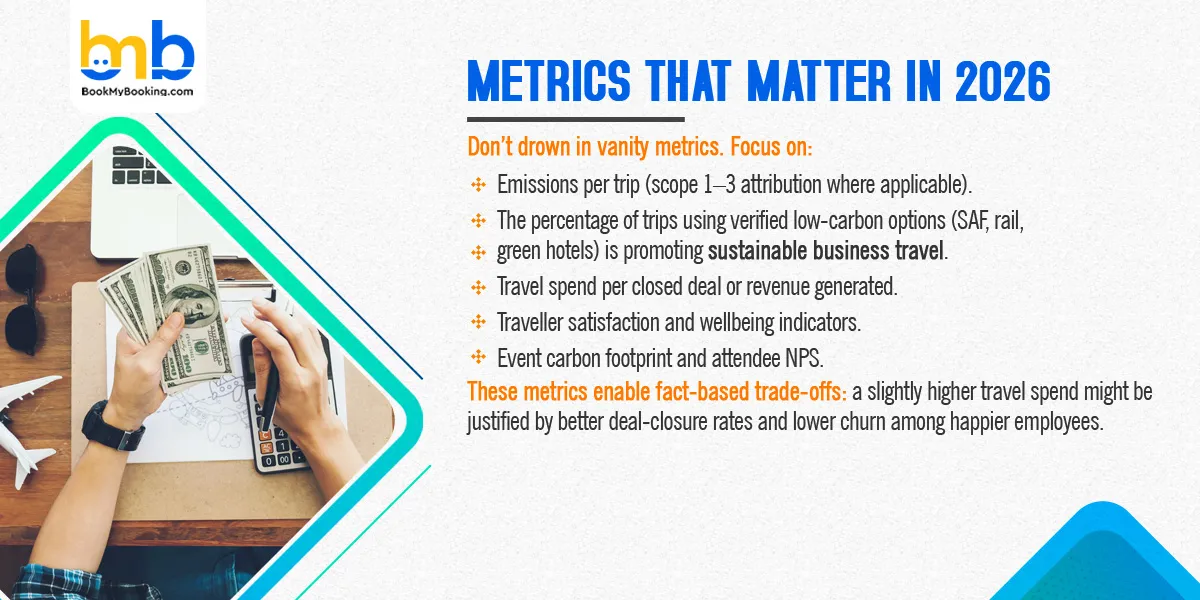
Finance, procurement, and sustainability teams will agree on KPIs: emissions per trip, percentage of trips with verified low-carbon options, travel spend per revenue dollar, traveller satisfaction scores, and event ROI metrics. Standardised reporting enables correlating travel with business outcomes.
Case examples: How industry leaders are adapting
- Integrated strategy and tech adoption: Leading travel management companies and platforms are already bundling carbon reporting, traveller apps, and AI-powered booking tools to deliver a unified experience for clients, which is an example of travel tech innovation. This trend accelerates the practical adoption of sustainability and automation across corporate programs.
- Banking on hybrid and regionalisation: Progressive corporations are moving from single global conferences to regional hubs linked virtually — a model that preserves the benefits of face-to-face networking while cutting travel and emissions.
- Sustainability commitments and net-zero roadmaps: Many hospitality groups and venues are publishing multi-year decarbonization roadmaps; corporate buyers prefer suppliers with credible, public commitments aligned with sectoral pathways that promote sustainable business travel.
Practical playbook for travel managers
- Integrate carbon tracking into T&E systems. Tag travel transactions with emissions data and create monthly dashboards for procurement and sustainability teams.
- Rewrite approval flows. Include carbon thresholds and ROI justification for high-impact trips.
- Negotiate supplier SLAs that include sustainability metrics. Ask hotels and airlines for concrete emissions reductions and access to SAF.
- Adopt AI-assisted booking tools. Using AI to present policy-compliant, low-carbon options tailored to traveller preferences is a travel tech innovation of today's world.
- Design “purpose-first” travel. Limit travel to activities with clear business outcomes and combine tasks into fewer, higher-value trips.
- Invest in traveller wellbeing-Policies for rest days, mental health support, and flexible travel classes as needed.
- Plan hybrid-first events. Ensure parity for virtual attendees and measure the event's carbon footprint.
- Pilot SAF and green procurement. Start with pilots on core routes and scale based on outcomes.
- Educate travellers. Launch concise guidance on low-carbon options, safety protocols, expense coding and eco-friendly travel as well.
- Measure travel ROI. Relate travel spend to revenue, deal closures, and customer/employee outcomes, not just headcount or trips.
Looking ahead: scenarios for 2026–2030
Three plausible trajectories:
- Accelerated green transition: Strong regulatory pressure, abundant SAF, and widespread supplier decarbonization are driving corporate travel to become both greener and more travel-tech innovation-driven.
- Measured evolution: Progress continues but unevenly across regions; corporates use offsets and technology to bridge gaps while prioritising high-impact cuts.
3. Economic backlash: Macro shocks force travel cuts and slow sustainability investments; however, the underlying push for purpose-driven trips remains.
Most likely: a hybrid of (1) and (2), progressive firms will lead, others will follow, and technology will accelerate adoption.
Final thoughts- Travel as a strategic lever
By 2026, future corporate travel will no longer be a behind-the-scenes operational cost — it will be a strategic lever for growth, culture, and sustainability. Organisations that combine smart tech, rigorous measurement, and human-centred policies will get the most value from travel budgets while reducing environmental impact. The winners will be those who treat travel decisions as integrated choices across procurement, sustainability, HR, and sales — not as a single department’s responsibility.